
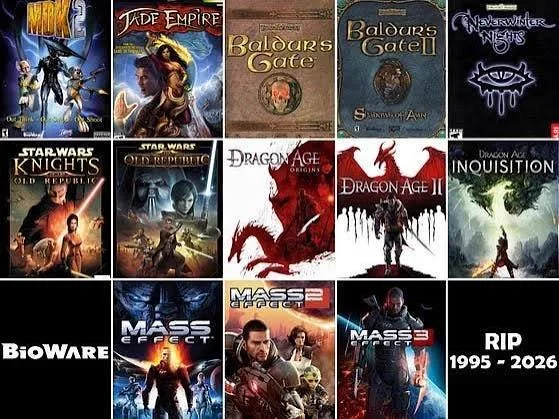
Last week, BioWare made an announcement that, while unsurprising, was disappointing all the same. After more than three decades of storytelling and game development, BioWare is closing.
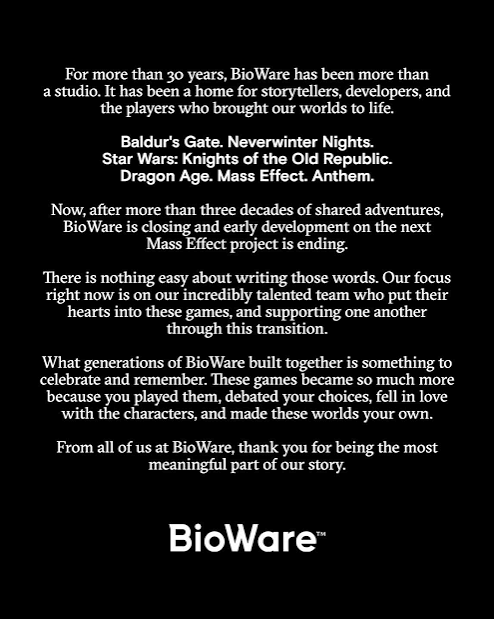
As I mentioned, this announcement unfortunately wasn't surprising to me or many others. BioWare has struggled to maintain the firm grasp it once had on the gaming community, particularly since the release of its Game of the Year winner, Dragon Age: Inquisition (2014), more than a decade ago. For a studio that once delivered hit after hit within a relatively short period of time, the signs of trouble became increasingly difficult to ignore. The Mass Effect trilogy (2007–2012) and the first three Dragon Age games (2009–2014) were released within just a few years of one another. By comparison, the much-anticipated fourth Dragon Age game faced delays and development issues that stretched across much of a decade.
A Farewell We Saw Coming
Following the announcement, BioWare fans and the gaming community in general went into overdrive with theories and accusations about what led to this outcome. From EA's acquisition of BioWare in 2007 to the switch to the restrictive Frostbite engine, reported rifts between the Mass Effect and Dragon Age teams, and constant shifts in development priorities, there has been no shortage of explanations. Many have also pointed to the studio's focus on multiplayer and loot-based games like Anthem (2019), rather than the complex, narrative-driven, choice-based experiences BioWare had become known for. Over the past several years, stories have emerged of original Mass Effect and Dragon Age writers and creative staff leaving the studio or being let go. The resulting changes in creative direction have been noticeable in games like Mass Effect: Andromeda (2017) and Dragon Age: The Veilguard (2024), neither of which quite lived up to the expectations established by their predecessors.
So while the announcement didn't come as a complete shock, it was still disappointing because many fans, myself included, continued to hold out hope. We hoped The Veilguard wouldn't be the end of the stories told in Thedas, which frankly deserved a better ending. We hoped the next Mass Effect game, announced in 2020, would fare better and improve on what was lacking in terms of story depth. But, as the recent announcement revealed, BioWare's closure also means the end of early development on the next Mass Effect project. And with it goes much of the hope we had for a BioWare resurgence.
Everlasting Stories
A glimpse at my back catalogue of articles will make it readily apparent that I'm a major BioWare fan. My introduction to the studio came through the Mass Effect trilogy, which I discovered on a cheap PS3 during a particularly difficult year of adulthood. I fell in love with the incredible storytelling and choice-based gaming experience that welcomed me into the world of Reapers, Mass Relays, and my beloved Normandy crew.

From there, I eventually ventured into the fantasy world of Thedas in Dragon Age, hesitantly, of course, because what could possibly top Mass Effect? As you can clearly see, I was once again enraptured by the stories I found myself at the center of, from my reluctant Grey Warden recruits in Dragon Age: Origins (2009), to Hawke's band of misfits in Dragon Age II (2011), to the powerhouse that was the Inquisition in Dragon Age: Inquisition (2014). All of them were simply doing their best to survive.
Each of these games offered an escape into narratives filled with heart, humor, and devastation. I'm not blind to the fact that none of them are without faults, but each offered something that made for a wonderfully immersive gaming experience, one that has stayed with me for more than a decade. And now, I and many other BioWare fans are left wondering: Will we ever experience that again? Or will our only option be to revisit these beloved games as time passes?
Where Do We Go From Here?
With BioWare's closure, there will undoubtedly be a void left in the gaming community. More games seem to focus on individual elements rather than offering the combination of features BioWare once brought to the table. Some games have rich, immersive stories, but limit players to a preset character design. Others offer detailed character customization, but pair it with a flat or linear narrative. Few RPGs offer choice-based adventures with branching pathways, and even fewer provide romance options with the same level of depth. It seems that more and more games are focused on instant gratification and action, rather than a deeper commitment to story and character.

Larian Studios' Baldur's Gate 3 (2023) filled the void many players had been hoping a new Dragon Age game would fill. That's particularly fitting when you consider that the first two Baldur's Gate games (1998 and 2000) were developed by BioWare. Larian has now turned its attention back to the world of its Divinity games, although the new project appears to be a fresh adventure rather than a direct continuation of the Divinity: Original Sin games (2014 and 2017). I have no doubt that Larian is capable of creating another game rich in character and lore, with choices that have far-reaching consequences. What remains unclear is how long we'll have to wait for its release. For now, all we have is a relatively vague description on Larian's website and a dark teaser trailer that puts Game of Thrones to shame.
Owlcat Games is another studio that has cited BioWare as a source of inspiration in its game development. Its upcoming game, The Expanse: Osiris Reborn (planned for Spring 2027), is an action RPG set in the universe of The Expanse novels by Daniel Abraham and Ty Franck. The game promises a sci-fi adventure with a deep choice-and-consequence system and romance options, making it a potentially appealing prospect for Mass Effect fans.
While we can look forward to these upcoming games with cautious optimism, we can also keep an eye on former BioWare employees and the projects they're pursuing in their new endeavors. David Gaider, the former lead writer for the Dragon Age games who left BioWare before The Veilguard, went on to co-found Summerfall Studios and write Stray Gods: The Roleplaying Musical (2023). While it isn't an action-packed RPG, it does offer branching, choice-based narratives and romance options. Gaider is also working with Summerfall on pitching a lighthearted heist RPG.
Archetype Entertainment, founded by former BioWare veterans James Ohlen, Drew Karpyshyn, and Chad Robertson, is developing EXODUS (2027). Described as a story-driven action-adventure RPG set in a new sci-fi universe 40,000 years in the future, the game will explore humanity's survival, its own evolution, and the effects of time dilation caused by interstellar travel. It also promises romances and difficult choices with real consequences. Meanwhile, Casey Hudson, former Mass Effect creative director and a lead designer on Star Wars: Knights of the Old Republic (2003), is spearheading the development of Star Wars: Fate of the Old Republic, another narrative-driven action RPG set in the classic Star Wars universe.
The Dawn Will Come
All this is to say that while I'm saddened to hear that BioWare is no more, I can still be forever grateful for the opportunity to become immersed in its stories and characters. Much like the choices in its games, BioWare has left an impact on the gaming community that continues to ripple outward, inspiring others to create and explore new narrative-driven gaming experiences. And with a stream of leaks about what was planned for the cancelled Mass Effect game, including a teaser trailer, there's now an online fan petition and even a public advertisement in Times Square as part of the #SaveMassEffect campaign. The hope is that another studio might be willing to pick up the project and continue its legacy.

To that end, I plan to celebrate what BioWare created rather than lament what was or what could have been. Over the past two years, I've completed full playthroughs of both the Dragon Age series and the Mass Effect trilogy, proving to myself that these games and their stories are just as enjoyable and captivating today as they were when I first played them. They're not simply benefiting from a nostalgia pass. I'm currently working on a Knights of the Old Republic (2003) playthrough, something I've been putting off for years, mainly due to the constant promises that a remake was just around the corner. And, of course, I fully intend to continue gushing about these stories and characters, recommending them whenever I can as I continue to write and create my own narratives.
As ever, I'm forever grateful to BioWare for creating games that were there for me during some of the roughest patches of my life. I wish the former employees continued success in their future endeavors, and I hope fans, old and new alike, continue seeking out the stories they love.
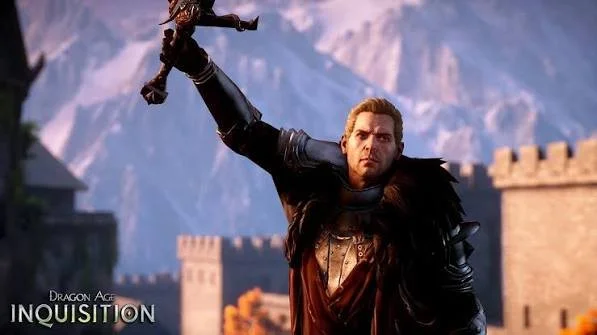
The night is long
And the path is dark
Look to the sky
For one day soon
The dawn will come
The Shepherd's lost
And his home is far
Keep to the stars
The dawn will come
Images are used under fair use for commentary and analysis. All copyrights remain with their original owners.
