
The Decagon House Murders: Unravelling a Mystery
Spoiler-free analysis!
It’s that time of year again. Spooky season is upon us. As I’ve mentioned before on this blog, I am not a person who often seeks out horror or scary stories. Given the option, I’d much rather escape into a thriller or suspense, which makes mystery stories a perfect match.
Growing up, I loved reading classic mysteries, with And Then There Were None by Agatha Christie and The Westing Game by Ellen Raskin being favorites that I still enjoy. Clue remains one of my top movies, combining humor and suspense into a wonderfully entertaining blend.
Lately, I found myself wanting to seek out some new books to discover and enjoy. After spending so much time developing my own YA fantasy series, I knew I needed a bit of a detox from that genre. So delving back into mystery novels seemed like an especially good call.
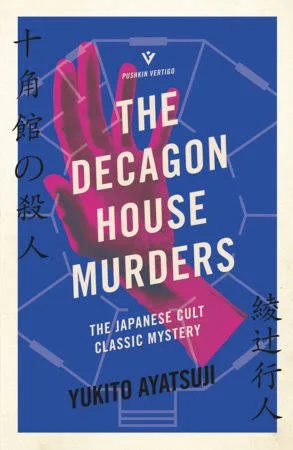
Of the books on my “to read” list, one that had been recommended and seemed particularly interesting was The Decagon House Murders by Yukito Ayatsuji. Originally published in Japan in 1987, the novel was first translated into English in 2015, with another English edition released in 2020.

One of the best mystery films ever. Meme by @mysterymanon
The Decagon House Murders takes an interesting approach to classic murder mystery tropes, with Ayatsuji drawing inspiration from And Then There Were None, which is even referenced within the story itself. The premise follows seven university students from different departments who are members of their campus Mystery Club, where they share a love of classic mystery fiction. They travel to a remote island with a tragic legacy, intent to spend a week in the Decagon House.
One interesting literary choice Ayatsuji makes is that the students are introduced to us by their inherited club nicknames, with each taking on the mantle of a renowned mystery author. Our cast of characters includes:
Ellery — a reference to Ellery Queen, the fictional detective and mystery-writing pseudonym.
Agatha — named after Agatha Christie, perhaps the most recognizable name in the group.
Leroux — a reference to Gaston Leroux, author of The Mystery of the Yellow Room and The Phantom of the Opera.
Carr — named for John Dickson Carr, famous for his locked-room mysteries.
Orczy — a reference to Baroness Orczy, creator of The Old Man in the Corner and The Scarlet Pimpernel.
Van — a reference to S. S. Van Dine, creator of detective Philo Vance.
Poe — named after Edgar Allan Poe, whose C. Auguste Dupin stories helped establish the modern detective story.

Depiction of the Decagon House from the paperback edition.
In a classic setting of an island with no contact with the mainland, the Mystery Club members take up residence in the Decagon House, a unique structure designed by the island’s former resident, an eccentric architect who was mysteriously murdered along with the rest of his household on the very same island earlier that year. Many questions still surround the nature of those deaths, making a stay on the island even more intriguing for several members of the Mystery Club.
Despite the high spirits among the group at first, there’s underlying tension between the club members from the start, revealing glimpses of their relationships, insecurities, and secret conflicts. They all have their own reasons for wanting to come to the island, with some more willing than others. But the excitement diminishes when they discover a chilling set of customized tablets within the Decagon House labeled: The First Victim, The Second Victim, The Third Victim, The Fourth Victim, The Final Victim, The Detective, and The Murderer.
Obviously, these fans of classic detective stories understand the setup. A challenge has been given. But what they don’t know is whether it’s a prank, a mere game for entertainment, or a legitimate threat. And more importantly, does the challenge come from within their own group or from somewhere outside it?
Everyone Wants to Play Detective
The cast of characters on the island shows a broad range of perspectives on how people might react to such a scenario. Some react with fear and concern. Others rely on observation and logical planning. Others seek immediate action and someone to blame. And some find that the only way to cope with the growing dread surrounding them is to take on the role of the detective characters they admire so much.
That fascination with playing a role became one of the more interesting aspects of the story for me. These aren't simply students who happen to enjoy reading and writing mystery stories. Their love of detective fiction has become part of how they understand the world around them, and in some cases, how they understand themselves.
“But this man wouldn’t settle for the role of a Watson, or a Lestrade either.”
That idea stuck with me because so much of the story revolves around the roles these characters believe they should play. Who gets to be the detective? Who becomes the observer? Who is willing to be the Watson standing beside the brilliant investigator, and who desperately wants to be the person solving the mystery? And who merely wants to survive to the endgame?
And perhaps that helps explain why anyone would willingly seek out the chance to stay on an infamous “murder island” in the first place.
I don’t wish to spoil the events of the book beyond what the title already reveals, so, yes, murders do start occurring within the Decagon House. The structure’s presence seems to take on a persona of its own in the way it impacts the characters, reminding me of another unsettling house.
The survivors scramble to find answers while knowing they are trapped on the island. Meanwhile, the narrative alternates between the rising dread on the island and an investigation on the mainland led by a former member of the Mystery Club, dubbed Conan, and Shimada, a mystery enthusiast who has a personal connection to the family murdered on the island previously.
The alternating perspectives add another layer to the mystery because the reader isn’t limited to the increasingly desperate circumstances on the island. We also get to watch an investigation unfold from the outside, slowly revealing connections between the present murders and the tragedy that occurred there before.
The Details in the Mystery
I never thought I’d know so much about different brands of cigarettes as I do now, but that was one of the fascinating details that came up often enough to make me want to learn more about what distinguished the brands and what that might say about the characters who smoked them.
Another recurring detail that caught my attention was how often the enjoyment of detective stories was viewed as a childish fancy. Even the characters who seem the most enamored with the idea of playing detective, such as Ellery, Conan, and Shimada, are sometimes described as immature or as acting without fully considering how their actions might affect others.
And perhaps that adds another layer to the idea of a group of students who would willingly seek out the chance to stay on an infamous “murder island” merely for the story and vibes, without fully taking into account the human element left behind by those tragedies.
That disconnect becomes increasingly interesting as the story progresses. The students are fascinated by mysteries as intellectual puzzles, but they are also surrounded by actual grief, guilt, and consequences. The question becomes whether their curiosity is helping them understand what happened or simply encouraging them to treat someone else’s tragedy as another mystery to solve.
“Was it all right for them to invade other people’s privacy just to satisfy their own curiosity?”
That question within the novel stood out to me because it gets at something deeper than the mechanics of the murder mystery. Curiosity is one of the things that makes mysteries so enjoyable. As readers, we’re constantly encouraged to look for clues, question motives, and dig into secrets. But there is a difference between wanting to understand something and believing we are entitled to every answer.
The Mystery Is the Story
The Decagon House Murders was an interesting read, and there were several elements that Ayatsuji handled very well. The novel does a great job of building suspense while having the characters themselves be so knowledgeable about classic mystery tropes. The growing tension and the way the murders are portrayed add to the fear the remaining club members would naturally be feeling as the situation continues to escalate.
Yet there were also some areas that I found lacking, and I realize that this comes down to personal preference and may partly reflect differences in how Western and Eastern fiction are structured. One area in particular was the relationships between the club members themselves. We are repeatedly told that it wouldn’t be unusual for these characters to go off to a remote island together because they are friends who hang out all the time. Yet we rarely see that close bond in action. There’s even a throwaway line about how two of the club members have been friends since childhood, but I don’t believe we ever see those characters interact on their own or think much about one another. And when the murders do start to occur, it honestly felt like most of the characters reacted with the cold detachment of hearing that a stranger had passed rather than losing a close friend. I understand that different people and cultures handle grief and fear in a variety of ways, but for a multiple-point-of-view narrative, I thought we would delve a bit more into some characters’ personal grief and loss.
In addition, there is a mysterious letter that sparks the mainland investigation involving Conan and eventually Shimada. They discover a connection between the letter and the group on the island involving another tragic accident that many wished would remain forgotten. While this shared tragedy is explored somewhat by the mainland investigators, we as readers are never given much insight into what fully occurred from the perspectives of the Mystery Club members who were actually present during the accident.
This was probably my biggest frustration with the novel. I wanted to understand not only what occurred, but how the characters themselves perceived what happened. The mystery surrounding the tragedy was interesting, but I sometimes felt like the emotional consequences were being held at a distance.
A Different Perspective
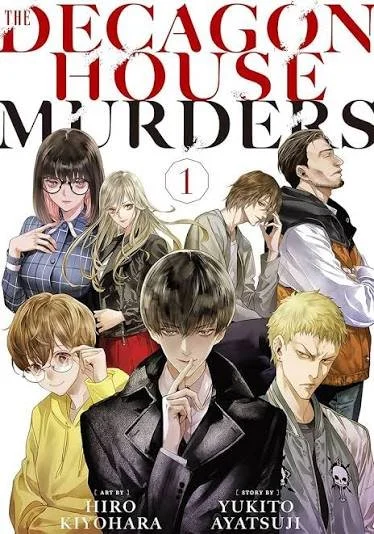
It is worth noting that many of my qualms with the story are addressed in the manga adaptation, which was released in 2019, with an English edition in 2021. After finishing the novel, I decided to check out the manga as well, and it includes a few story alterations and additions, including small character moments and interactions that I feel help flesh out the characters and their relationships.
I also discovered there’s a 2024 miniseries adaptation of The Decagon House Murders, and I keep debating whether it’s worth renewing my Amazon Prime subscription to check it out. I’ll probably wait until my next Prime discount is offered, but it’s definitely something I’d like to see, especially to find out how it handles some of the elements of the story that rely heavily on its narrative structure.
A Mystery Is a Game
One of the quotes that resonated with me most came from the novel’s own discussion of mystery fiction:
“In my opinion, mystery fiction is, at its core, a kind of intellectual puzzle... A game between the reader and a great detective, or the reader and the author.”
That really is the appeal of a good mystery. We want to play along. We want to notice the clues, question the suspects, and see whether we can figure out the answer before the detective does. The Decagon House Murders understands that fascination and builds its entire premise around characters who are already familiar with the rules of the game.
But the novel also asks what happens when the game stops being fiction.
The characters come to the island because they are fascinated by the story surrounding it. They want to understand the mystery left behind by the murders. They want to play detective. But once the deaths become real, the distinction between solving a puzzle and confronting human suffering becomes much harder to ignore.
So if you’re in the mood for a puzzle-filled murder mystery on a foreboding island, I do recommend The Decagon House Murders for a suspenseful read this spooky season. Both the novel and manga are entertaining reads, so choose the one that best suits your tastes. Can you determine who the traitor is among the faithful before the next murder occurs? Wait, I’m just talking about Celebrity Traitors UK again, which is also entertaining.
But in all seriousness, for an intriguing read that shines a light on guilt, loss, insecurities, and the roles we assign ourselves to survive, I definitely suggest you check out this book. I’m already planning on reading the rest of Ayatsuji’s novels to discover what other mysteries await.
Images are used under fair use for commentary and analysis. All copyrights remain with their original owners.
