
Confronting Personal Demons: Part 2 Lucanis vs. Anders
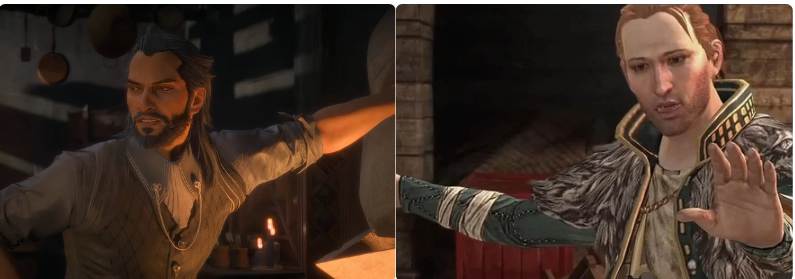
Spoiler warning for Dragon Age: Origins, Dragon Age 2, and Dragon Age: The Veilguard! If you’re still playing, come back later.
Last week, I explored how a well-developed character can be portrayed while confronting their personal demons, using Anders from Dragon Age II (2011) as a case study. However, the Dragon Age series also offers an example of what happens when that kind of development falls short. And for that, we must once again visit the franchise’s most recent entry, Dragon Age: The Veilguard (2024).
I know it’s hard to believe after how I’ve talked about The Veilguard in past articles, but I do think the game does some things right (something I’ll need to elaborate on in a future post). Unfortunately, those strengths do not extend to the areas the series once excelled at so beautifully: world-building, character development, and romances. Dragon Age: The Veilguard is a solid video game, but it is not a good Dragon Age game. If it had been the first RPG I ever played, I probably would have been blown away by it. Sadly, it wasn’t my first RPG, and it certainly wasn’t my first Dragon Age, so I went in with years of expectations and high hopes.
Ironically, I barely knew anything specific about the game itself before playing. I’m one of those weirdos who avoids anything beyond teaser trailers because I don’t want to be spoiled.
So when I entered the world of Dragon Age: The Veilguard, I was genuinely excited. I was eager to explore a new part of Thedas, meet new characters, and see what trouble Solas had managed to stir up this time. And, perhaps most importantly, I was excited to discover which character would become my Rook’s “canon” romance.
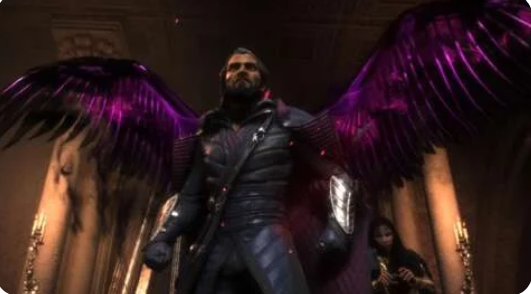
You gotta admit, the man has style.
You can imagine, then, how intrigued I was when I learned my next recruit would be “The Demon of Vyrantium: The Mage Killer,” better known as Lucanis Dellamorte. An Antivan Crow who hunts mages? My Tevinter mage Rook could barely contain her anticipation for the angsty romance surely waiting in the wings (pun intended). After all that buildup, I was thrilled to finally meet Lucanis after rescuing him from an underwater prison, where he had been held captive and tortured by Venatori mages.
Lucanis makes an impressive entrance, and his story becomes even more intriguing when it’s revealed that, during his captivity, he was forcibly merged with a demon of Spite as part of the Venatori’s experiments. Somewhere in the background, my Anders-loving Hawke was cheering. The angst levels were rising. Let’s see what Lucanis has in store for us.
And unfortunately… it turns out there wasn’t much.
Perhaps my expectations were unfairly high from being shaped by Anders’ portrayal, or by the depth typically afforded to companions throughout the Dragon Age series, but Lucanis fell particularly flat for me. Not because he lacked interesting components, but because he had so much potential.
Lucanis isn’t just a man forced to share his body with a demon of Spite; he also belongs to the faction I was most excited to revisit in The Veilguard: the Antivan Crows. He was raised in a prominent family within the assassin guild, which was an infamous organization first introduced in Dragon Age: Origins (2009) through Zevran Arainai, a Crow initially hired to kill the Grey Warden and later able to become a companion.
Zevran, for all his charm and cavalier humor, reveals the darker reality of the Antivan Crows: an organization that recruits orphans and raises them in a brutal, cutthroat environment designed to produce killers. Yet once again, The Veilguard strips away the morally grey complexity of the faction Rook must work alongside. The Antivan Crows we encounter are portrayed as valiant, charming vigilantes whose methods, power, and manipulation are never meaningfully questioned.
As a result, Lucanis himself becomes a watered-down character.
This is a trained assassin who was imprisoned and tortured for a year and forcibly merged with a demon, and yet, there is no real bite to him. No edge. We watched Anders struggle for years with his bond to the spirit of Justice, a connection he willingly invited, constantly fighting to remain himself and resist the pull toward vengeance. By comparison, Lucanis and Spite (a literal demon forced into his body) treat their connection like a mild inconvenience.
Spite throws the occasional tantrum, takes control during a few rare moments when Lucanis tries to sleep, and is framed as more irritating than dangerous. Like a disgruntled pet. Aside from attacking in one emotional scene after a boss fight, Spite, who I feel like must again stress is a literal demon, never truly feels like a threat to anyone except Lucanis himself, whom he slaps during one of those aforementioned tantrums. That’s the extent of it.
There were so many elements here that could have supported a compelling character study. Instead, the writing gives us a moody man who wants to drink coffee, fulfill contracts, never sleep, and—perhaps most egregiously—never flirt with Rook.
Yes, I’m still bitter about his lackluster romance. It had so much potential. Bless the fanfiction writers who stepped in to fill that void. This man was in desperate need of them. I cannot stress how much I fumed when we helped this man buy a thoughtful gift for everyone else in the group except Rook. Yes, that “date” is still one of my save files. And yes, it’s labeled, "THE COFFEE IS MY GIFT” as a way to somehow justify me romancing him. And yes, I’m still as bitter as his precious coffee knowing he gleefully flirts with Neve any chance he gets.
Sigh. I should refocus.
Anders works as a tragic figure because his flaws, strengths, and bond with Justice shape every interaction he has with the world, with his companions, and with the player. His choices carry weight. He argues. He challenges authority. He lashes out when opposed. And his actions force players to grapple with uncomfortable questions: What rights should people be afforded, regardless of background? And how far is someone willing to go in the name of Justice?
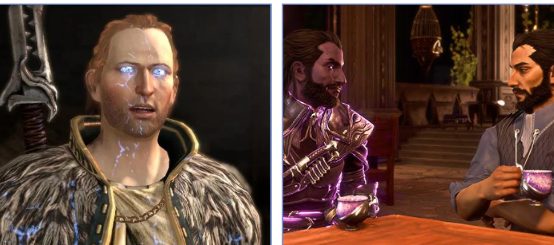
Anders (and Justice) looking on in horror as Spite and Lucanis resolve their issues over coffee.
Lucanis, by contrast, presents no real moral quandary. The so-called Mage Killer shows little concern about working alongside mages, reserving his hostility only for the game-designated “evil mages” of the Venatori. His forced bond with Spite resolves itself with surprising ease. Within weeks, Lucanis makes a pact with the demon to seek revenge, and the two settle into a disturbingly functional coexistence.
Perhaps most disappointing of all, Lucanis is never given space to question what being an Antivan Crow truly means to him.
For that depth, I highly recommend the anthology Dragon Age: Tevinter Nights (2020), specifically the short story “The Wigmaker Job.” In just a handful of pages, it does more to characterize Lucanis and his family than hours spent with him in The Veilguard. After finishing my first playthrough, I was deeply unsatisfied with many aspects of the game, particularly Lucanis’ portrayal as both a character and a romance option, so I decided to check out this anthology.
The Lucanis we meet in “The Wigmaker Job” is dynamic, conflicted, charming, and terrifyingly competent. It sheds meaningful light on what being an Antivan Crow costs him and, tragically, reveals just how much The Veilguard stripped him of his agency and personality.
So please read “The Wigmaker Job.” Read Tevinter Nights. Seek out fanfiction that fills the void The Veilguard leaves behind. Discover the depth and complexity we could have had if the game hadn’t fallen into so many narrative traps due to development and production constraints.
Because when it comes to confronting personal demons, we can only judge Lucanis by the source material of Dragon Age: The Veilguard. And unfortunately, he lacks the personality, depth, and relatable flaws that Anders embodied more than a decade earlier.
When I finished Lucanis’ story, I felt disappointed and unfulfilled. In contrast, Anders left me shaken to my core, replaying conversations, questioning my Hawke’s choices, and wondering whether the ends could ever justify the means. That kind of lasting unease is rare in games, and it’s exactly why Anders remains such a powerful example of effective character writing all these years later.
Any images referenced or used in this article are included under fair use for the purposes of commentary, criticism, and analysis. All characters, images, and properties remain the intellectual property of their respective rights holders.
