
Confronting Personal Demons: Part 1
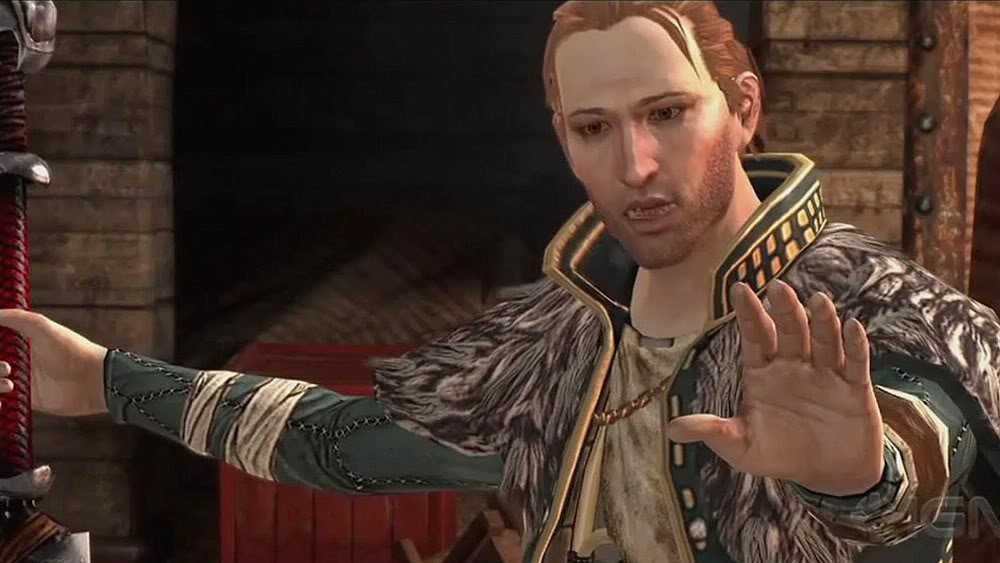
“Wait, who said I was problematic?”
Spoiler warning for Dragon Age: Origins - Awakening and Dragon Age 2! If you’re still playing, come back later.
One aspect of strong characterization is crafting someone who is flawed yet genuinely striving to do good. But what happens when that same character becomes so consumed by a cause that it distorts their judgment, their relationships, and even their sense of self? Do they lose what made us root for them or do they become even more tragically relatable?
The Dragon Age series excels at introducing characters who force players to sit with uncomfortable moral dilemmas. Few characters embody this complexity more fully than Anders from Dragon Age II, whose internal conflict has a literal manifestation in the form of a spirit of Justice.
Players first meet Anders and the spirit of Justice in the expansion Dragon Age: Origins – Awakening (2010). Anders is presented as a runaway mage, an apostate, who has spent most of his life trying to escape the oppressive oversight of the Circle of Magi and the templars who police it. He’s witty, opinionated, charmingly selfish at times, and deeply shaped by his ongoing fight for personal freedom. Justice, in contrast, is a spirit from the Fade whose purpose is exactly what his name implies: upholding justice for the wronged. Throughout Awakening, Justice attempts to navigate the complexities of human morality, learning that not every wrong is simple, and not every act of justice can be straightforward.
By the time we meet them again in Dragon Age II (2011), it’s revealed that Anders and Justice have merged. Anders explains that he offered himself as a host to help a friend, believing that Justice would also be a powerful ally in the fight for mage rights. But the revelation raises uncomfortable questions. Mages in Thedas are vulnerable to possession, risking becoming abominations. So as players, we are forced to question if the merging of Anders and Justice is a reliable asset or a liability.
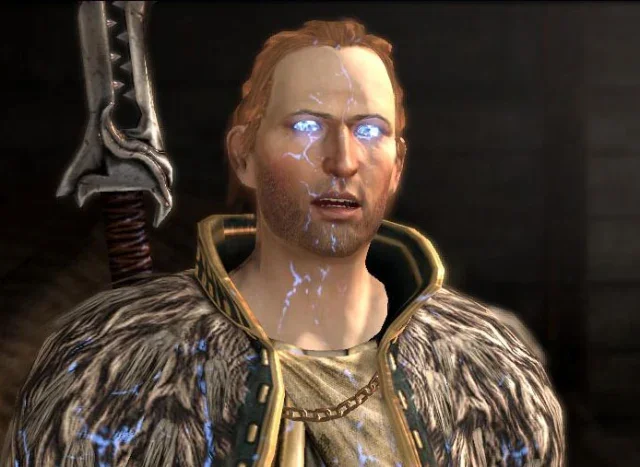
“Yep, this is totally normal. Nothing to worry about.”
Unlike in Awakening, we don’t interact with Justice as a separate personality in Dragon Age II. Instead, he erupts through Anders during moments of emotional intensity, particularly when Anders believes violence or harsh judgment is the only solution. These flashes often push situations far beyond anything black and white. Meanwhile, Anders struggles with his own growing anger, frustration, and instability as the mage–templar conflict intensifies over the course of the game’s multi-year narrative.
As mentioned in previous posts, I did the unthinkable and played the Dragon Age series backwards. I started with Inquisition (2014), moved to Dragon Age II, and only then played Origins and Awakening. Because of that, I went into DA2 with a very different perspective than most players. I already knew about the broader debates surrounding mage freedom. I’d seen the horrifying implications of Tranquility where mages who were considered a threat were severed from their connection to the Fade and stripped of their emotions. I’d met Cole, a spirit of Compassion living in a human body, who complicated the question of how spirits and humans can (and can’t) coexist.
All of this made me deeply sympathetic to Anders from the start. He’s introduced in Dragon Age II as a talented healer running a secret clinic in Kirkwall’s poorest districts, portraying a charming rebel with a tragic past and a righteous cause. My Hawke, a mage herself, immediately wanted to fight beside him. And yes, the energy was very much “I can fix him.”
But as years pass in Kirkwall, Anders’ desperation and fury begin to grow. His willingness to listen diminishes. His fixation sharpens into a frightening clarity. The same passion that once made him admirable becomes a warning sign for what’s coming. The city’s tensions escalate, and Anders’ internal battle with Justice (and with himself) escalates alongside it.
Watching my Hawke’s romance with Anders unfold was both beautiful and heartbreaking. The tenderness was there, but so was the slow unraveling. And that unraveling forces players to ask a powerful question:
Did Justice’s righteous certainty corrupt Anders?
Or did Anders’ trauma and rage corrupt Justice?
Perhaps the real tragedy is that both are true. Either way, the result is one of gaming’s most debated character arcs that still sparks passionate discussion over a decade later.
Anders isn’t the only character in Dragon Age whose sense of justice consumes him. In Part 2, I’ll explore his surprising narrative parallels with Lucanis from Dragon Age: The Veilguard, a character whose upbringing and internal conflict raise their own set of moral questions. While Anders is shaped by trauma and an ideological crusade, Lucanis is molded by legacy and duty, yet both men struggle beneath the weight of a personal “demon.” Stay tuned as I compare where their stories converge, where they clash, and what their journeys reveal.
All referenced video games and images are reviewed under Fair Use for purposes of commentary, reflection, and literary analysis. All rights belong to their respective copyright holders.
